DecisionSaaS cost guide
Systeme.io Free Plan: What You Actually Get (and What You Don't) in 2026
Short answer: Systeme.io's free plan gives you 2,000 contacts, 3 sales funnels, 1 online course, 1 blog, 1 custom domain, unlimited email sends, unlimited file storage, and zero transaction fees on sales. It doesn't expire, and it doesn't ask for a credit card. For a lot of beginners, it is genuinely enough to run a small business on — not a trial, an actual working plan.
The limits that will eventually stop you are funnels and courses, not contacts. Here's the full picture.
Disclosure: this page contains affiliate links. If you sign up through one of them I may earn a commission at no extra cost to you.
What "free" actually means here
Most platforms use "free" to mean a 14-day countdown that auto-bills you, or a stripped-down version with 500 contacts and none of the useful features locked in.
Systeme.io's free tier is a different thing. It's a permanent plan with no expiry and no card required at signup, and the core tools are the same ones paid users get. You're not on a lesser version of the software — you're on the same software with lower capacity ceilings.
That distinction matters, because it changes the question from "how long do I have before I have to pay?" to "how big do I need to get before paying makes sense?"
Everything included on the free plan
Contacts and email
- 2,000 contacts
- Unlimited email sends — no cap on volume, no charge per send
- Email campaigns and one-off newsletters
Selling
- 3 sales funnels
- 0% transaction fees (you keep everything minus your payment processor's cut)
- Stripe and PayPal both supported
- Order bumps and one-click upsells
Content
- 1 online course, with unlimited students
- 1 blog
- 1 website
- Unlimited file storage
Other
- 1 custom domain
- 1 affiliate program (yes, you can run your own affiliates on the free plan)
- Marketing automation and workflows
- Access to the same support channels as paid users
Two of those deserve a moment. Unlimited email sends on a free plan is close to unheard of — most email tools price by list size or send volume, and this one does neither. And unlimited students on your one course means a free-plan user can technically sell a course to a thousand people without paying Systeme.io a cent.
Where the free plan actually stops you
Now the honest part. Here's what runs out, in the order it usually runs out.
1. Funnels — the real ceiling
Three funnels sounds like plenty until you start building. A lead magnet opt-in is one funnel. A sales funnel for your product is two. A webinar registration is three. You're done.
If you sell more than one thing, or you like testing different offers, this is where you'll hit the wall — often within the first couple of months. Plan your three carefully rather than burning one on an experiment.
2. Courses — one is one
If you have a second course, a mini-course lead magnet, or you want to split a big program into two products, you need to upgrade. There's no way around this one.
3. Automation depth
Simple flows work fine: someone opts in, a tag gets added, a welcome sequence fires. What the free plan isn't built for is complex branching logic with lots of conditional paths. If you're mapping out a fifteen-branch nurture sequence, you'll feel the constraint.
For most beginners this is a non-issue, because most beginners don't need fifteen branches — they need one welcome sequence that actually goes out.
4. Systeme.io branding
Free-plan pages carry Systeme.io branding. Whether that bothers you depends entirely on who's looking at your pages and how polished you need to appear.
Who the free plan is genuinely enough for
You can run a real business on this tier if you're:
- Selling one digital product or one course
- Building an email list under 2,000 people
- Running a lead magnet → welcome sequence → offer funnel
- Testing whether an idea has any buyers before spending money on it
That last one is the underrated use. Being able to validate an offer end-to-end — landing page, opt-in, email sequence, checkout — at zero cost removes the most common excuse for not starting.
Who will outgrow it fast
- Anyone with multiple products or multiple offers running at once
- Anyone whose list is already past 2,000
- Anyone who needs several courses or a tiered product ladder
- Anyone who needs pages without third-party branding on them
When upgrading makes sense
The Startup plan is $17/month and raises you to 5,000 contacts, unlimited funnels, and 5 courses. Realistically, the trigger for most people isn't the contact limit — it's the third funnel. The moment you want a fourth, $17 is an easy yes.
Above that: Webinar at $47/month (10,000 contacts, plus automated evergreen webinars) and Unlimited at $97/month (unlimited contacts, sub-accounts, and free migration if you're moving from another platform). Annual billing takes roughly 17% off any tier.
The honest downsides
I'd rather you hear these from me than find them in month three.
The templates look dated. This is the most consistent criticism of the platform, and it's fair. The page and email designs are functional rather than beautiful. If visual polish is central to your brand, you'll want to do custom work or look elsewhere.
Analytics are shallow. You get open rates, click rates, and basic contact growth. Revenue attribution and deeper cohort analysis aren't there.
Support is hit or miss. The company advertises fast average response times, and plenty of users confirm that. But slow replies and scripted answers are a recurring complaint in public reviews. Support quality is the most common gripe across review sites.
None of these are dealbreakers at $0. Some of them are worth weighing at $97.
Free plan vs. the GoHighLevel question
This comes up constantly, so: GoHighLevel has no free plan at all. It starts at $97/month and bills SMS, phone, and email usage on top of that.
They're not really competitors so much as tools for different people. Systeme.io is built for one person selling digital products. GoHighLevel is built for agencies and service businesses managing leads and clients through a pipeline. The overlap on funnels and email makes them look similar on a feature list, and they aren't.
👉 Not sure which one fits you? Take the 60-second quiz — eight questions, no email required, and it tells you which platform matches how you actually work.
Create a free Systeme.io account here — no card required, and it never expires. If you read this and realised you need SMS and a real CRM instead, GoHighLevel's trial is the other direction.
Frequently asked questions
Does the Systeme.io free plan expire?
No. It's permanent, and no credit card is required to create the account.
Can you sell products on the free plan?
Yes, with 0% transaction fees from Systeme.io. You'll still pay standard Stripe or PayPal processing fees.
Can you use your own domain on the free plan?
Yes — one custom domain is included.
What happens to my contacts if I downgrade from a paid plan?
Contacts above the 2,000 limit get archived rather than deleted. Reactivate a paid plan and they come back.
Is there a catch?
The realistic catch is the funnel limit, not anything hidden in the terms. Three funnels is where most active users hit friction, and $17/month is the fix.
Plan details verified August 2026 against Systeme.io's official pricing page. Plans and limits change — check current pricing before signing up.
Not sure which platform fits?
Take the DecisionSaaS quiz and compare your budget, workflow and growth plans.
Take the free quiz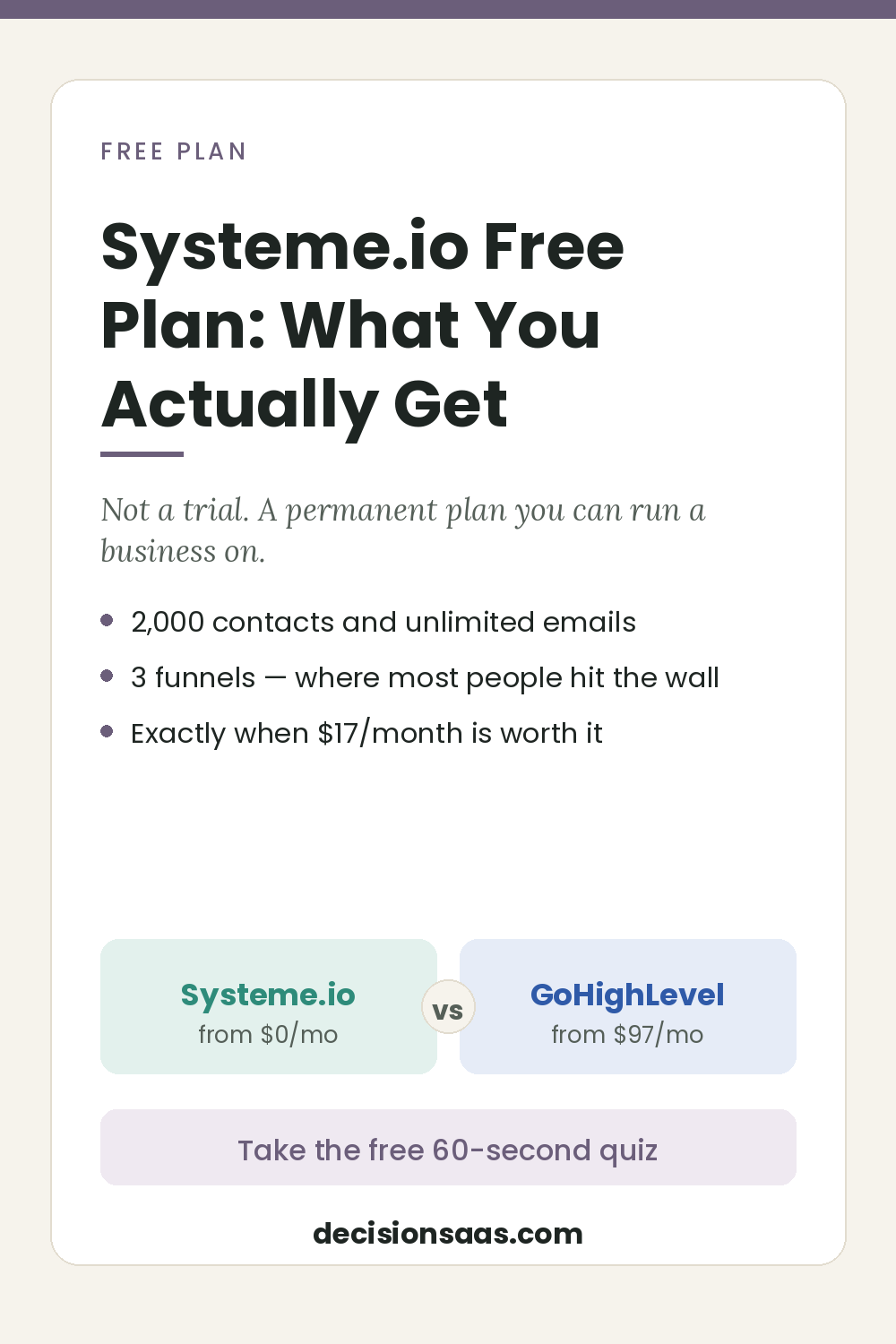
Prices and plan details can change — verify the latest pricing before purchasing.
Made to help you choose. Some links are affiliate links.